
Account expansion usually does not fail because Account Managers lack effort.
It fails because the motion depends too much on memory, manual work and disconnected tools.
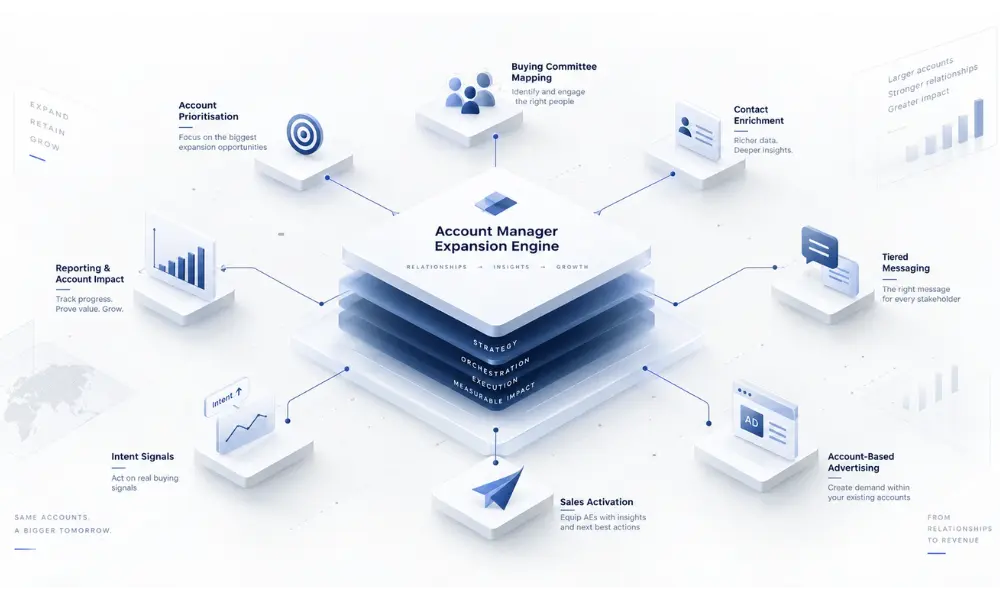
This playbook shows how I turn the pieces that already exist, AM knowledge, marketing, sales tools and reporting, into one repeatable expansion system.
Chady Mouawad · GTM & Growth Strategist · Updated September 2026
The goal is to help Account Managers reach more relevant people inside the accounts they already own — without replacing the relationship they have built. The system prioritises the right accounts, expands the buying committee, warms the audience, surfaces meaningful intent and gives the AM a clearer next action.
The AM knows the portfolio, marketing knows the personas, sales tools can automate touches, and reporting can show what worked. The pieces exist. The system often does not.
Segment the accounts, cluster them into focused plays, map and enrich the right people, tier the message, warm the account, watch for intent, then activate sales.
The Account Manager owns the relationship. The GTM Engineer builds the system around it.
Expansion becomes fragile when it lives in the AM’s memory or depends on one-off manual effort. The result is usually the same: familiar contacts get all the attention, missing stakeholders stay invisible, and tools create activity without creating a coordinated account motion.
The GTM Engineer builds the operating layer around the Account Manager: account segmentation, cluster research, ICP and contact mapping, data cleanup, tiered messaging, account-based ads, intent alerts, outreach automation and campaign reporting.
The system exists to increase the number of relevant contacts who know their dedicated Account Manager — not to automate the relationship itself.
Use it when the account already has a commercial relationship and there is a credible reason to expand into more stakeholders, buying centres, use cases or projects.
The sequence is deliberate: decide where expansion potential exists, make the account list more focused, map the people who matter, then use data, media, signals and outreach to create warmer and better-timed conversations.
Decide which accounts deserve attention, group them into usable plays and map the buying committee before activation begins.
The first job is not to contact every account. It is to decide where expansion has the best chance of creating revenue. That can be a specific industry, account cluster or language market — but the reason for prioritising the account must be explicit.
Existing relationship, past activity, new buying centre, strategic fit and current account context.
Rank accounts by expansion potential and agree the priority with the AM before activation starts.
A focused list of accounts with a clear expansion reason and priority.
AM role: Validate where the commercial upside is real and where timing makes the account worth working now.
Turn the broad account list into focused plays. Clustering gives marketing and sales a repeatable reason to use similar messaging, targeting and activation across accounts without treating the whole portfolio the same.
Priority accounts, industry, geography, use case, buying pattern and expansion reason.
Group accounts around shared characteristics that can support one coherent play.
Focused account clusters that can share targeting and messaging logic.
AM role: Pressure-test whether the cluster makes sense commercially, not just statistically.
Once the account clusters are clear, map the people who can shape the next project: technical users, project owners, buyers or procurement, and decision-makers. The aim is to expand the conversation beyond the AM’s existing relationships.
CRM contacts, enrichment data, known relationships and persona criteria.
Identify the relevant roles, uncover missing personas and map why each person matters in the account.
A buying-committee view showing known contacts and the gaps still to fill.
AM role: Add relationship history and influence that a job title alone cannot show.
Prioritise and enrich the right contacts, then build message tiers that reflect their role and importance inside the account.
Not every contact belongs in the same motion. Separate people by relevance and readiness so the campaign can treat an active opportunity contact differently from a future-pipeline lead or a newly enriched contact.
Opportunity status, CRM history, contact source, relationship stage and current expansion activity.
Place contacts into Active Focus, Future Pipeline or Low Awareness.
A contact-priority model that determines message depth, content and outreach intensity.
AM role: Confirm who is already commercially active and where outreach should stay lighter.
Before activation, update the data for each tier. The point is to avoid reaching people who changed role, left the company or no longer fit the buying committee.
Current role, email, LinkedIn, seniority, role changes, buying-committee fit and missing contact details.
Refresh known contacts, detect role changes and add missing stakeholders.
A cleaner, current contact set the AM can trust.
AM role: Correct stale relationship data and validate which people still matter inside the account.
The message should change with the contact’s context. Active Focus can be direct and account-specific. Future Pipeline should be more educational and value-led. Low Awareness needs a light introduction and simple proof.
Contact tier, account context, use case, case studies, guides, webinars and proof points.
Match the message angle and supporting content to the contact segment.
Three message tiers that reflect different levels of relationship and readiness.
AM role: Add account-specific context and remove anything that would feel generic or out of place.
Warm priority accounts, detect meaningful intent and automate the mechanics around timely sales activation.
When people inside the account see the AM’s name, face, value proposition or a relevant use case before the email or LinkedIn message, the outreach feels less cold.
Priority account audiences, contact personas, account-specific themes and relevant proof.
Run account-based ads that reinforce the same story the AM will use in outreach.
More familiarity before direct outreach starts.
AM role: Use that familiarity as air cover, not as a substitute for a real account conversation.
Do not alert the AM for every click. Highlight activity that is meaningful: repeated visits, key page views, content engagement, or several contacts from the same account showing interest.
Website visits, key pages, content engagement, repeated activity and multi-contact account signals.
Define the signal thresholds and route only meaningful activity to the owner.
Context-rich alerts that tell the AM where attention is building.
AM role: Judge whether the behaviour changes the commercial picture and decide whether to follow up.
Automation can handle email and LinkedIn touchpoints at scale, but each tier should have its own sequence, timing and message angle. Replies and real conversations go back to the AM.
Segmented contacts, message tiers, timing rules, email and LinkedIn sequences.
Automate the repetitive touches, stop when the contact engages, and hand the conversation back to the AM.
Consistent coverage without automating the human relationship.
AM role: Own every genuine reply and move the conversation forward personally.
Close the loop by measuring account movement and using the results to improve the next expansion cycle.
Reporting should show whether the campaign created useful movement inside the account — not just whether messages were sent or clicked.
Contacts reached, replies, interest, warmer accounts, meetings and opportunity movement.
Review which contacts responded, which accounts warmed up and where the AM should focus next.
A practical view of account movement and the next set of priorities.
AM role: Validate whether the reporting matches what is really changing inside the account.
The play is working when more relevant people inside the account know the AM, more accounts become meaningfully warmer, and sales has a clearer view of where to focus next.
Did we reach beyond the same known contacts and cover more of the buying committee?
Which accounts showed repeat engagement or stronger multi-contact interest?
Did the motion create replies, meetings or useful follow-up for the Account Manager?
Did any account progress toward an opportunity, new project or broader relationship?
The PDF uses three tiers because relationship stage should change both the message and the amount of pressure applied.
Contacts linked to current opportunities and active account-expansion efforts. Use direct, account-specific messaging and relevant proof.
Relevant CRM contacts who may support future opportunities. Use educational, value-led content to build familiarity.
Newly enriched contacts who fit the buying committee but are not yet engaged. Keep the first touch light and proof-led.
Download the PDF version of the playbook, or go back to the full GTM Playbooks library.