
High-intent buyers are already on the website, but most teams still treat that activity like reporting data instead of GTM action. This playbook defines what intent actually means, turns the behaviour into an account list, scores it with fit and timing, and routes the right next action without exposing the tracking behind it.
Chady Mouawad · GTM & Growth Strategist · Updated September 2026
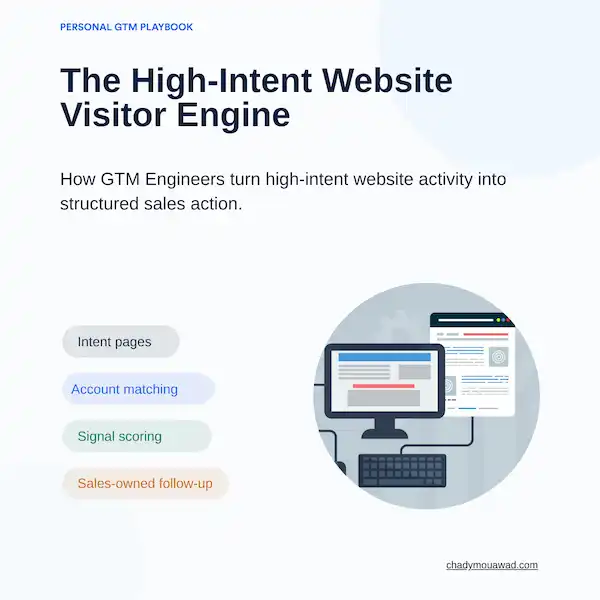
The job is not to alert sales whenever someone visits a page. It is to separate meaningful buying behaviour from noise, connect the signal to the right account and buying committee, then decide whether the next move is sales follow-up, retargeting, nurture, AM outreach or no action.
Marketing sees the activity, sales needs the context, RevOps owns routing, and the tools capture signals — but website intent often never becomes a clear next action.
Define high-intent pages, build and clean the account list, map the buying committee, score fit plus timing, choose the message tier, route the signal and stop automation when a buyer engages.
Intent should guide relevance, not expose surveillance. Use the signal to choose the message and the timing — never tell the buyer you were watching their page visits.
Some buyers visit pricing pages. Some compare solutions, read case studies or check integrations. Those actions can be commercially useful, but only if the team has agreed what they mean and how they should change the next GTM action.
A GTM Engineer does not just report who visited the website. The operating job is to define which signals matter, which accounts should be prioritised, who is in the buying committee, what message should be sent, who owns follow-up and when sales should step in.
Without matching, scoring, routing and suppression, website intent is just another dashboard metric.
Use it when the website has identifiable commercial or evaluation pages, account matching is available, and the team can connect the resulting account behaviour back to CRM ownership and follow-up rules.
The playbook moves from definition to matching, mapping, scoring and activation. The important part is that action only happens after the account context is understood.
Define what high intent means, build the account list, clean the data and establish the buying context before activation.
Not every website visit is a buying signal. The playbook separates commercial and conversion intent, research and evaluation intent, and low-value pages that should be excluded or down-weighted before any alert or outreach exists.
Pricing, demo, contact, trial, product, solution, comparison, alternatives, case studies, ROI, security, careers, blog and support pages.
Classify pages by buyer intent. Treat pricing and conversion pages as strongest, research pages as meaningful evaluation, and careers/blog/support as low buying intent.
A clear intent-page taxonomy with priority and exclusion rules.
Owner role: Agree which behaviours are commercially meaningful enough to influence sales action.
Once intent behaviour is defined, turn the website activity into an account list. The list should explain which company visited, what they viewed, how often they returned and what relationship already exists.
Matched company, page history, visit frequency, CRM presence, owner, customer status and opportunity status.
Aggregate website behaviour at account level and attach basic CRM context.
A high-intent account list that sales and marketing can inspect together.
Owner role: Validate whether the account is relevant and whether someone already owns the relationship.
Before activating anything, connect website visitors to the right account records and remove the data problems that create false signals.
Company domains, CRM accounts, existing records, visitor matching and account status.
Match the account, remove duplicates, merged accounts, non-potentials, wrong domains and competitors, then separate customers, open opportunities, churned and net-new.
A clean account record with a trustworthy relationship status.
Owner role: Resolve ownership conflicts and confirm which account record should drive routing.
The goal is not just finding a contact. It is mapping the people who influence, approve, block or champion the decision inside the account before outreach begins.
Existing CRM contacts, known engaged leads, previous buyers, product users, decision-makers and missing personas.
Map the decision-maker, technical evaluator, procurement or security role, and champion or operator.
A buying-committee view with missing roles identified.
Owner role: Confirm the realistic entry point and where an existing relationship should override enrichment.
Combine fit and timing to prioritise the account, then decide which message tier makes sense for the relationship and signal strength.
Before activation, score accounts on both who they are and what they did. Strong intent without fit is not automatically a sales opportunity.
ICP fit, company size, industry, region, revenue potential, page value, engagement depth, recency and buying context.
Weight account fit, page value, number and depth of visits, recency and whether the account is already a customer, opportunity or target.
A prioritised intent score that reflects fit, behaviour, timing and context.
Owner role: Set the threshold for sales attention and challenge accounts that look active but do not fit.
Use the signal to decide what kind of message makes sense without exposing the tracking behind it. The right motion changes with relationship status as much as intent level.
Known high-intent account, open opportunity, existing customer, net-new target, medium or low intent.
Route known high intent to sales, open opportunities to the opportunity owner, customers to AM or CS, net-new to contact mapping first, and lower intent to nurture or retargeting.
A message and treatment tier for every account type.
Owner role: Choose the business context for the message without referencing the tracked behaviour directly.
Turn the signal into coordinated action through routing, retargeting and contextual outreach without exposing the tracking behind it.
Once the account is scored and the message tier is defined, decide what action should happen next. The PDF explicitly includes sales alert, retargeting, contextual outreach, nurture and owner tasks.
Intent score, account status, message tier, ownership and buying context.
Connect each signal to the right motion: sales follow-up, retargeting, nurture, AM outreach or no action.
A rule-based activation path instead of a generic alert queue.
Owner role: Own the selected motion and make sure the account does not receive conflicting actions.
A website signal is only useful if the right person sees it quickly. Routing should respect account and opportunity status, post-sale ownership and suppression rules.
Open opportunity, strategic-account status, customer status, assigned owner, suppression status and competitor identification.
Route open opportunities to the AE, strategic accounts to the account owner, customers to AM or CS, unowned accounts to assignment, and suppressed accounts to no action.
A signal with explicit ownership — or an explicit suppression decision.
Owner role: Act quickly when the signal is yours and avoid duplicate outreach when another owner already has the account.
Some accounts need familiarity before a direct message. Retargeting keeps the brand visible and reinforces the proof point most relevant to the page or topic the account is exploring.
Pricing, product, comparison, security and case-study visitor audiences.
Match the retargeting content to the observed research theme: ROI and proof, use cases, differentiation, trust, security or customer outcomes.
A warmed account audience with more relevant proof before sales engagement.
Owner role: Treat retargeting as air cover, not as evidence that the buyer wants a call.
Outreach should be useful. Do not say ‘I saw you visited our pricing page.’ Use the signal to choose the message, then lead with the business question a buyer in that situation is likely to care about.
Intent theme, account context, buying committee, message tier and owner.
Translate the signal into relevant business context without exposing the tracking mechanism.
A contextual email or sales touch that feels informed rather than invasive.
Owner role: Personalise the message around the account’s likely question, not the website event itself.
Stop automation when the buyer engages and use downstream outcomes to improve scoring, routing and prioritisation.
Once a buyer replies, books a meeting, requests a demo, starts a trial or enters an active sales conversation, the automation should stop or adapt. This is where many intent campaigns break.
Replies, meetings, demo or trial requests, wrong-person responses, ‘not now’, negative replies and unsubscribes.
Stop automation for positive signals, update the buying committee for redirects, move ‘not now’ to nurture and suppress negative or unsubscribe signals immediately.
A controlled handoff from automated activation to the appropriate human or nurture state.
Owner role: Take over the real conversation and keep the buyer out of overlapping automation.
Reporting is not there to prove website traffic. It should sharpen what the team acts on next.
Accounts identified, fit score, high-intent accounts touched, response rate, meetings, pipeline influenced and opportunities created.
Compare signals with downstream outcomes and adjust page weights, thresholds and routing based on what produced useful action.
A stronger prioritisation model and fewer false-positive alerts.
Owner role: Close the loop by telling the system which signals actually matched sales reality.
The source playbook keeps reporting focused on whether intent identification improved prioritisation and pipeline — not whether website traffic increased.
How many accounts were matched, and how strong was the fit score behind them?
How many qualified high-intent accounts were actually touched by the right owner?
Did the activated accounts reply, book meetings or move into a real sales conversation?
What pipeline was influenced and how many opportunities were created?
The PDF makes the routing logic relationship-aware. The same level of intent should not trigger the same action for an opportunity, a customer and a net-new target.
Known high-intent accounts and open opportunities get owner-led follow-up with clear commercial context.
Existing customers go to AM or CS. Net-new target accounts should be mapped to the right contacts before direct outreach.
Medium or low intent stays in education and retargeting until there is enough evidence for direct sales action.
Download the High-Intent Website Growth Engine PDF, or go back to the full GTM Playbooks library.